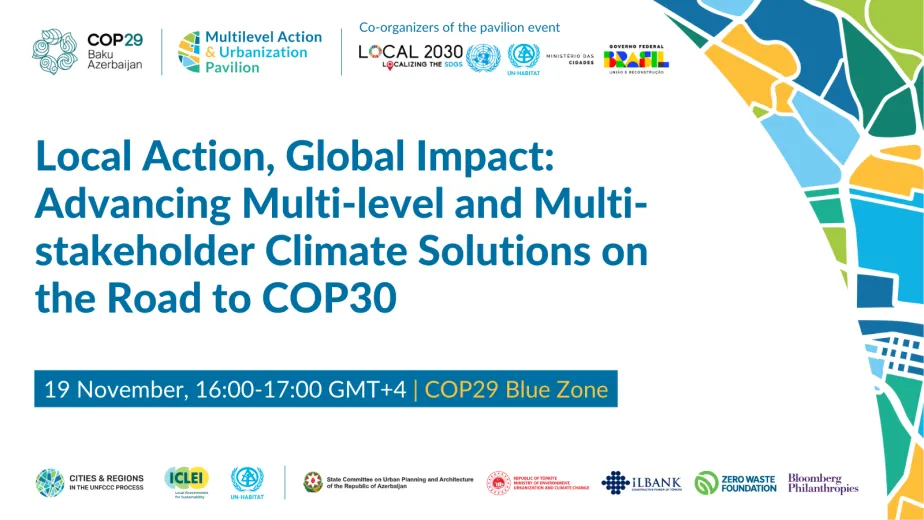
Local Action, Global Impact: Advancing Multi-level and Multi-stakeholder Climate Solutions on the Road to COP30
Organized by
Local2030 Coalition, UN-Habitat, Ministry of Cities of Brazil
Add to Calendar
In the wake of rising inequalities, climate change and the multiple crises facing our world today, governments at all levels, stakeholders and communities are taking action at the local level to ensure that no one and no place is left behind and that people and the planet are protected.
The 2024 SDG Report shows only 17% of the Sustainable Development Goals’ targets are on track, with 30% seeing minimal progress and over 30% stalled or regressing. As global efforts continue to accelerate the achievement of the SDGs, there is an increasing emphasis on the power of localizing the SDGs, ensuring their implementation comes from the ground up and is rooted in community-led efforts. This involves tailoring the goals to local contexts and ensuring that local and regional governments, stakeholders from all sectors and local communities are actively engaged in the implementation process of the 2030 Agenda.
2024 and 2025 mark pivotal moments for advancing the localization of the SDGs and climate agenda. Key milestones, such as COP29 in Baku, Azerbaijan, and COP30 in Belém, Brazil, offer unique opportunities to accelerate climate action through multi-level governance and multi-stakeholder collaboration. These events build on the momentum generated by the Summit of the Future, the World Urban Forum, and the G20 Brazil Summit, all of which have called for a revitalized, more inclusive multilateral system and reform of the global financial architecture.
To scale up the impact of COP29 and COP30 and ensure it is part and parcel of the UN’s broader SDG localization agenda and that its outcomes feed into the implementation process of the SDGs, it is essential that it be interconnected to the other main advocacy milestones linked to the SDGs taking place in the lead-up to COP30. As the UN platform that supports the on-the-ground delivery of the SDGs, acting as a convergence point between local and regional governments and their associations, national governments, businesses, community-based organizations and other local actors, and the United Nations system, the Local2030 Coalition has a unique role to play in this regard, ensuring that UN initiatives at COP29 and COP30 feed into the overall multilateral development agenda.
Within this context, the Local2030 Coalition, UN-Habitat and the Ministry of Cities of Brazil, will co-organize a side event at the COP29 Multi-level Action and Urbanization Pavilion facilitated by UN-Habitat and the LGMA Constituency aiming to bring together representatives from different levels of governance and from different sectors to discuss i) how an effective multi-level and multi-stakeholder roadmap in 2025 can contribute towards a successful COP30; and ii) explore what mechanisms need to be put in place to ensure that strategies for developing, implementing, and following up on Nationally Determined Contributions (NDCs) are ambitious, rooted in communities, and guided by SDG localization. Particular emphasis will be placed on how multi-level and multi-stakeholder cooperation can accelerate the implementation of the Paris Agreement while achieving the SDGs. The event will share best practices from a UN system-wide perspective, from national and local government representatives that will offer a strategic opportunity for participants to discuss synergies and scale up efforts from COP29 to COP30 and beyond. The meeting will ensure a link between COP29, COP30 and the High Impact Initiative on SDG Localization as well as the localization of the six SDG transitions.
Objectives
- Illustrate concrete examples of local-level policies and initiatives leading to more impactful climate action that are multi-level and multi-stakeholder in nature, spotlighting specific initiatives such as CHAMP.
- Scale up actions that can have multiplier effects and that accelerate the implementation of the SDGs through the lens of the six SDG transitions and that consider key climate issues such as Nationally Determined Contributions, youth empowerment, climate and gender equality, and sustainable oceans, among others.
- Foster dialogue on the follow-up to COP29 and the role of multistakeholder collaboration in SDG localization with a particular focus on increasing capacities and financing at the local level in preparation for FFD4 and COP30.
Expected outcomes
- Demonstrate models and initiatives that illustrate effective collaboration among stakeholders, inspiring concrete commitments and partnerships for climate action.
- Generate actionable recommendations and commitments from stakeholders to enhance local capacities and secure sustainable financing for the development of NDCs that are guided by SDG localization.
- Develop follow-up strategies towards COP30.
Participants
Member States, local and regional governments and their networks, the private sector, academia and UN entities.
