Scaling up local action and finance
-
Events
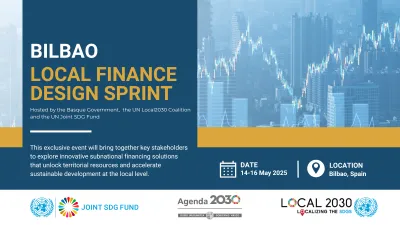
The Bilbao Local Finance Design Sprint: Scaling Local Solutions through Strategic Financing
Event details Date: 14-16 May 2025 Location: Bilbao, Spain Duration: Three business days Number of participants: 30 Co-hosted by the Basque Government, the Joint SDG Fund and the Local2030 Coalition Background The Joint SDG Fund drives systemic transformation toward the Sustainable Development Goals (SDGs) through integrated programming focused on identifying and supporting innovative policies and financing solutions. Under the leadership of Resident Coordinators, the Fund accelerates key SDG transitions at country level by fostering collaboration across UN entities, ensuring alignment with national priorities, and mobilizing diverse multi-stakeholder partnerships and financing for maximum impact. The Fund has demonstrated remarkable operational results to date, with its USD344 million in commitments catalyzing USD6.6 billion in additional investments—a 1:19 leverage ratio. In 2024 alone, USD1.6 billion was leveraged through innovative financing, notably through sustainability bonds in Indonesia. Additionally, the Fund secured USD25 million in blended investments through renewable energy partnerships with commercial banks. The Fund's initiatives have reached over 206 million people to date, showcasing its effectiveness in service delivery and community capacity building. The Local2030 Coalition is the UN system-wide platform and network for supporting and accelerating the localization of the 2030 Agenda for Sustainable Development. The Coalition brings together 14 UN entities, local and regional governments and their associations, national governments, businesses, community-based organizations, and other local actors to mobilize, empower and support local stakeholders in advancing the 2030 Agenda. In 2024 the Joint SDG Fund and Local2030 Coalition joined forces to launch a dedicated portfolio of catalytic initiatives in 30 countries that can clearly demonstrate the role of SDG localization in accelerating the SDGs from the ground up. The Basque Government has funded more than 1,300 projects in 65 countries, and it has recently legislated to dedicate 0.7% of its budget to international cooperation and is historically one of the leading players worldwide in terms of decentralized Official Development Aid (ODA). The Basque Country commitment to the 2030 Agenda is based on a traditional consensus and shared comprehensive vision of sustainable development with a systemic approach to territorial impact and transformation. In this context, the support to the Secretariat in Bilbao and the Local Coalition 2030 is conceived as an important Basque contribution to a platform for the creation of localization models. This successful experience localizing SDGs could certainly serve as a blueprint for mobilizing citizenship ownership, capacity building and innovation in local actors, both local governments, local business communities, civil society and local knowledge sources in order to foster and strengthen public-private alliances and creating roadmaps, all these conditions to ease the necessary enabling environment for the attraction of sustainable investments to the territory. This workshop represents a strategic convergence of these three partners, building on their shared commitment to localizing the SDGs through innovative financing approaches. The collaboration leverages the Joint SDG Fund's catalytic financing experience, Local2030's localization network, and the Basque Government's practical expertise in territorial development financing to advance concrete solutions for food systems and green economy transformation at the local level. Rationale and Objectives This design workshop aligns with the 2025 Fourth Financing for Development Conference (FfD4) priorities, building on the draft outcome document which emphasizes that territorial approaches are essential for materializing development commitments and that sustainable transformations require coordinated investments from multiple sources within coherent policy frameworks driven by public-private collaboration. As a proof of concept that local finance is development finance, the workshop focuses specifically on financing for food systems and green economy transformation - a critical SDG acceleration strategy. While the UN Food Systems Summit established national pathways, implementation at the territorial level remains severely underfunded, particularly in Least Developed Countries (LDCs) and complex settings where food insecurity and climate vulnerability challenges are most acute. In these contexts, territorial systems and markets serve as the backbone of sustainable food systems and inclusive green economies, yet local governments and other stakeholders face significant barriers to mobilizing investments for agri-food systems resilience, green infrastructure, and circular economy innovations. The workshop will bring together multi-level, multi-stakeholder actions to co-create a collective blueprint of solutions for unlocking finance for subnational food systems and green economy transformation. Participants will collaboratively develop financing models for territorial development tailored to each country context and to local needs and priorities, outlining: Principles and frameworks for aligning local financing with local priorities and national pathways for food systems and/or green economy transition strategies Financial instruments and mechanisms tailored to territorial contexts Policy frameworks and implementation strategies that enable multi-stakeholder engagement to create the necessary enabling environment and market-ready solutions and mobilize investment at the subnational level Moreover, the workshop will create space for building connections and partnerships, including national, regional and local governments, with the World Bank, impact investors, philanthropists, and international cooperation entities including decentralized actors, to generate support for scalable and locally tailored financing solutions. This convening represents a critical opportunity to establish a network of practitioners and financiers who will continue advancing financing solutions that successfully drive food systems transformation at the local level, demonstrating how a systems approach to subnational financing can create concrete pathways for sustainable development in line with both FfD4 objectives and food systems transformation goals. -
Actualizaciones
Bilbao to Host Global Design Sprint to Finance Food Systems and Green Energy Solutions
ActualizacionesBilbao to Host Global Design Sprint to Finance Food Systems and Green Energy Solutions
Press Release Bilbao, Spain, 29 April 2025 – The city of Bilbao will host The Bilbao Local Finance Design Sprint: Scaling Local Solutions through Strategic Financing from 14 to 16 May 2025. Sponsored by the Basque Government, co-hosted by the United Nations Joint SDG Fund and the United Nations Local2030 Coalition, co-organized by the World Rural Forum and in collaboration with the City of Bilbao and the BBK Foundation, this three-day in-person workshop will convene 50 global experts and stakeholders to co-create a collective blueprint of solutions for unlocking finance for subnational food systems and green economy transformation. “By combining the Joint SDG Fund’s catalytic financing expertise, the Local2030 Coalition’s localization expertise, and the Basque Government’s hands-on experience in territorial development financing, this workshop aims to lay the foundation for scalable solutions in food systems and green economy transformation at the local level,” said Sébastien Vauzelle, Head of the Secretariat, UN Local2030 Coalition. "The Bilbao Design Sprint marks a turning point in sustainable development financing. Following the Basque Government's leadership, the Joint SDG Fund and the Local2030 Coalition are combining catalytic financing with localized expertise. The blueprint developed in Bilbao will provide invaluable guidance ahead of the Fourth Financing for Development Conference (FfD4), helping us scale local priorities that deliver on the 2030 Agenda for Sustainable Development, and guide our work around the globe to accelerate the Sustainable Development Goals (SDGs)," said Lisa Kurbiel, Head of the UN Joint SDG Fund Secretariat. As part of the “Road to Seville: The Local Way” process, this workshop comes at a pivotal moment – only two months ahead of the Fourth Financing for Development Conference, which places a strong emphasis on the territorial implementation of the Sustainable Development Goals. The event will demonstrate how local finance solutions can serve as a powerful catalyst for systemic change, particularly in Least Developed Countries (LDCs) and regions facing complex vulnerabilities. In 2024, the Joint SDG Fund and the Local2030 Coalition joined forces to launch a dedicated portfolio of catalytic initiatives in 30 countries that clearly demonstrates the role of SDG localization in accelerating the SDGs from the ground up. This year, the Bilbao workshop will convene local and national government representatives, UN country teams, and stakeholders from eight different countries as well as financing experts from diverse UN entities, leading Basque representatives of public and private institutions, practitioners from the World Bank, impact investors, philanthropists, and other financial institutions from around the world. Based on territorial proposals and localization experiences and expertise, participants will collaborate to design scalable and practical financing solutions tailored to specific country contexts, focusing on: Principles and frameworks for aligning local financing with local priorities and national pathways for food systems and/or green economy transition strategies. Financial instruments and mechanisms tailored to territorial contexts. Policy frameworks and implementation strategies that enable multi-stakeholder engagement to create the necessary enabling environment, market-ready solutions, and mobilize investment at the subnational level. Based on the Basque model that exemplifies the territorial approach promoted by the Local2030 Coalition in general and the event in particular, the workshop will culminate in the endorsement of the “Bilbao Action Plan” – a strategic blueprint that, together with the localization marker, outlines financing solutions for territorial transformation with a systemic approach, particularly in complex settings and LDCs. It will also deliver ready-to-implement prototype solutions that integrate local SDG financing mechanisms, investment frameworks, and policy innovations, each with clearly defined implementation pathways. In addition, the event will contribute to the creation of a dynamic multi-stakeholder platform that brings together financial institutions, impact investors, national and local governments, the World Bank, and UN teams to enable sustained collaboration in local SDG financing and support the global scaling of similar initiatives. This represents a first step toward supporting other countries in adapting and adopting this territorial approach to implementing the 2030 Agenda. About the Partners The Basque Government has funded over 1,300 international projects in 65 countries and has recently legislated to dedicate 0.7% of its budget to international cooperation –positioning itself as a global leader in decentralized Official Development Aid. The Basque Government’s support for the Local2030 Coalition’s Secretariat in Bilbao reflects a significant contribution to the development of models for SDG localization. Building on its successful track record, this experience offers a potential blueprint for mobilizing citizenship ownership, building capacity, and fostering innovation across key actors, including local governments, businesses, civil society, and knowledge institutions. By promoting strong public-private alliances and the creation of roadmaps, this approach helps establish the enabling conditions needed to attract sustainable investment to the territorial level. The Joint SDG Fund accelerates progress toward the Sustainable Development Goals by supporting innovative policies and financing solutions. Under the leadership of the United Nations Resident Coordinators, the Fund accelerates key SDG transitions at country level by fostering collaboration across UN entities, ensuring alignment with national priorities, and mobilizing diverse multi-stakeholder partnerships and financing for maximum impact. The Fund has delivered strong results, using US$ 344 million in commitments to unlock an additional US$ 6.6 billion in external investments. Its initiatives have reached over 206 million people to date, showcasing its effectiveness in service delivery and community capacity building. The United Nations Local 2030 Coalition is the United Nations’ system-wide platform for the localization of the 2030 Agenda for Sustainable Development. It ensures that the UN system is equipped to align global goals and national policies with local contexts, needs, and priorities, while securing a one-UN approach to localization. Through its five constituencies—national and local governments, civil society and academia, the private sector, and youth—the Local2030 Coalition serves as a convergence point between the United Nations system and local development stakeholders, enabling connections for higher impact and systemic transformation, with a focus on those furthest behind. The World Rural Forum (WRF) is a diverse network that promotes Family Farming and Sustainable Rural Development, composed of Family Farming federations and organizations such as COPROFAM, PIFON, PDRR, PROPAC, and AFA, rural development organizations such as INADES, and cooperatives and agricultural research centers such as CIRAD. The organization's social objective, "Promoting Family Farming and Sustainable Rural Development," emphasizes the promotion of sustainable rural development on five continents, improved public policies for family farming and their effective implementation, gender equity in family farming and rural development, the integration, incorporation, and equal participation of young people in family farming and rural development processes, and support for the strengthening and empowerment of family farming organizations and other organizations working in rural areas. BBK Foundation is a banking foundation that has always been connected to the reality of Bizkaia and dedicated to solving its challenges. For more than 100 years, the city has led projects to address the needs of Bilbao and Bizkaia at every moment. It is an organization committed to finding solutions to the social needs of people, promoting culture, and promoting the development and well-being of Bizkaia. The BBK Foundation, a partner in the creation and support of the Secretariat of the Local 2030 Coalition, obtains its resources through the management of its assets and the economic benefits it receives from Kutxabank, of which it is the majority shareholder. The city of Bilbao is committed to becoming a global leader in sustainable development, as evidenced by the fact that it hosts the headquarters of the United Nations Local2030 Coalition Secretariat, which promotes the global localization of the 2030 Agenda. Since 2019, Bilbao has adopted the 2030 Agenda and the SDGs as the strategic framework for strengthening the social contract and municipal strategies for coexistence and values. Today, Bilbao's goal and its Agenda 2030 plan focus on achieving a more humane, livable, inclusive, and equal city. A more competitive city to attract public and private investment for a long-term project to transform the city and its citizens toward sustainability. This workshop represents a strategic convergence of these partners, based on their shared commitment to localizing the SDGs through innovative financing approaches. --- For more information, please contact: Ms. Elizabeth Paturzo at [email protected] and Mr. Iñigo Arbiol at [email protected].
The Bilbao Local Finance Design Sprint: Scaling Local Solutions through Strategic Financing
Bilbao to Host Global Design Sprint to Finance Food Systems and Green Energy Solutions
Bilbao to Host Global Design Sprint to Finance Food Systems and Green Energy Solutions
Localizing finance for development: The role of the Local2030 Coalition
The Local2030 Coalition serves as the United Nations system-wide platform and network dedicated to supporting and accelerating the localization of the 2030 Agenda for Sustainable Development. By bringing together the United Nations system, national, local and regional governments, civil society, academia, the private sector and other stakeholders, the Coalition connects global goals and national policies with local contexts, needs and priorities, while advancing locally led action and systemic territorial transformation. Financing is central to this mission.
The Coalition strengthens capacities and financial systems at the local level, promotes local financing solutions, instruments and innovations, and builds partnerships with national development banks, international financial institutions and development partners to increase local impact.
This agenda is driven by the core proposition that local finance is development finance. Through its partnership with the Joint SDG Fund, the Coalition has advanced practical approaches to localizing finance, including a dedicated Sustainable Development Goal (SDG) localization portfolio and the SDG Localization Marker. Ahead of the Fourth International Conference on Financing for Development (FfD4), held in July 2025, the Coalition advanced this agenda through the "Road to Seville: the Local Way" initiative. This process included the United Nations system-wide policy brief Local Finance is Development Finance and a series of multi-stakeholder consultations that integrated local perspectives and financing solutions into the global Financing for Development process. The Bilbao Local Finance Design Sprint, held in May 2025, formed a key part of this process, providing a practical demonstration of how local financing solutions can catalyze systemic change and contribute directly to global development objectives.
-
Library
Financing Policy Brief Series: Recommendations for FFD4: Local Finance is Development Finance
LibraryFinancing Policy Brief Series: Recommendations for FFD4: Local Finance is Development Finance
To effectively implement the 2030 Agenda and its Sustainable Development Goals, it is essential to support the development of national policies and devise solutions that enhance the role and capacities of local and regional governments. Strengthening their public financial management practices, institutional frameworks and technical capacities on financing can significantly improve local service delivery, infrastructure management and private investment, and enhance local economic development. This can be achieved by developing and delivering comprehensive institutional and capacity strengthening programmes, facilitating exchange and learning and providing resources for best practices, as well as improving access to data that informs decision-making processes. A critical component of this effort is strengthening financial systems and capacities at the local level within an integrated approach to financing. -
Events
Building Financial Sustainability through Localization: Side Event at the Twelfth Session of the World Urban Forum
Today’s global development and humanitarian challenges are vast, demanding, and complex, and the achievement of the SDGs is behind track. While all the SDGs have targets directly related to local action, most of the resources have been concentrated at the national level, impacting local actors’ abilities to promote integrated, inclusive and sustainable territorial development. The challenges facing the achievement of the SDGs are also inherently local, shaped by the unique histories, power dynamics, and other factors specific to each context in which they occur. This means that the SDGs can only be achieved if all relevant local actors fully participate in the agenda-setting, implementation, and monitoring of sustainable development projects and investments. Therefore the meaningful engagement of local actors in receiving and managing financing has become increasingly critical to accelerating SDG progress, and there has been rapid recognition of the need to channel development funding to the local level. However, this shift in financing requires new multi-level and multi-stakeholder approaches and solutions for the challenges preventing local action, including absorbing financing at the local level and building long-term local financial sustainability. USAID has led the way in recognizing the importance of shifting donor funding to the local level and has set two key targets to guide its pursuit of locally led development: (1) 25% of funding will go to local impact by 2025; and (2) At least half of USAID programs will promote space for local actors to exercise leadership over priority setting, activity design, implementation, and defining and measuring results by 2030. USAID holds itself accountable to these targets through metrics measuring (1) progress against these targets by the percentage of funding that is channeled directly to local partners and (2) the percentage of programs that are locally led in ways that elevate local leadership. USAID’s localization efforts include: (a) adapting policies and programs, (b) shifting power to local actors, (3) channeling a larger portion of funding directly to local partners, and (d) serving as a global advocate and thought leader. The Local2030 Coalition is the UN System-wide platform and network for supporting and accelerating the localization of the 2030 Agenda for Sustainable Development. The Coalition brings together the UN system, local and regional governments and their associations, national governments, businesses, community-based organizations, and other local actors to mobilize, empower and support local stakeholders in advancing the 2030 Agenda for Sustainable Development. The goal is to strengthen coordination within and beyond the UN system by enabling multi-level and multi-stakeholder collaboration, which is essential for coherent and effective actions on complex and interlocking challenges. To this end, the Local2030 Coalition facilitates a convening space to support partners in developing ideas and sharing tools and approaches to advance the 2030 Agenda everywhere. Localizing development is a process of empowering all local stakeholders aimed at making sustainable development more responsive and, therefore, more relevant to local needs and aspirations. Improving and unlocking access to financing for local actors is critical to accelerating balanced sustainable development investments. Through the Local2030 Coalition, the UN System is unified around the need to understand and scale up localization action and financing. This joint session of USAID and the Local2030 Coalition will explore approaches undertaken in directing resources to local partners and supporting domestic resource mobilization. The networking event will engage donor and financial institutions, the UN System, and local actors in a dialogue to better understand bottlenecks, challenges, and lessons and best practices on channeling finance to the local level achieve the SDGs. It will bring together theory and practice to consider effective responses to the ‘asks’ of local actors. The event aims to engage and encourage discussion and progress on better enabling local action through fiscal impact on the SDGs through local level financing to enable local action. The discussion will connect these issues with the Financing for Development process on the road to the Fourth International Conference on Financing for Development (FfD4) to take place in Spain. The format will create a forum for frank conversations and interaction on the importance of putting the needs and priorities of local actors first and international donors and institutions are working to support and strengthen local actors’ efforts to meet their needs and achieve the SDGs. Attendees will hear from practitioners who are advancing localization and have an opportunity to compare methods on how best to elevate local partners. With finance serving as a central pillar to local governments’ ability to deliver public services that advance development outcomes, this session aims to shed meaningful light on the topic of how prepared local governments and partners can effectively utilize more resources and assets, creating long-term financial sustainability. The panel will speak to approaches that enable local communities to invest in effective public financial management, ultimately ensuring local partners and communities will have the best opportunity for success. The first segment will provide an opportunity for exchange and discussion on the critical questions challenges and bottlenecks that local actors face in building financial sustainability and accessing, absorbing, managing, and maintaining financing at the local level. In the second segment, panelists will reflect on good practices and recommendations for optimizing access to financing and efficiency at the local level to build financial sustainability. Each segment will invite engagement and insights from the audience through a Q&A period. Key Objectives Foster a space for discussion and exchange to engage and support funding and financing organizations to channel more financing towards local level to achieve the SDGs, demonstrating impact and highlighting the opportunities and positive downstream effects of local level financing (e.g. increased participation, stakeholder engagement and empowerment) Highlight how the shift towards local financing can be done in an effective way, avoiding pitfalls and providing the lessons learned, potential opportunities, and recommended ways to avoid and address challenges and traps so that international partners can iterate on these examples. To present key learnings and provide insights for institutions that have primarily worked with financial support to the national level to effectively support local-level action and implement local financial supports. To provide examples of how these concepts on how to work more directly and comprehensively with local partners have been deployed in practice. To collect and understand insights and input on the topics and approaches discussed, including challenges and lessons learned from local actors in accessing and building sustainability in local financing. This feedback and the concerns and questions raised by local actors will be integrated into a joint USAID and Local2030 Coalition publication compiling good practices and guidelines on access to financing for local actors to advance the SDGs. Supporters USAID Local2030 Coalition -
Library
SDG Localization Marker
LibrarySDG Localization Marker
The SDG Localization Marker was developed through a collaborative process led by the Joint SDG Fund and the Local2030 Coalition, with contributions from representatives of international and regional organizations, national and local and regional governments, civil society, academia, youth organizations, and the private sector. These stakeholders shared their expertise and perspectives throughout the consultation, review, and validation process. The Joint SDG Fund and the Local2030 Coalition also wish to acknowledge the valuable support of the Government of Spain in developing the SDG Localization Marker. They further extend their appreciation to the United Nations entities that are members of the Local2030 Coalition— DCO, FAO, ILO, IOM, UN DESA, UN Women, UN-Habitat, UNDP, UNEP, UNFPA, UNHCR, UNICEF, WHO, and the UN Regional Economic Commissions—as well as to the Coalition's partners, for their technical guidance, coordination support, and editorial contributions throughout the development process. -
Library
Road to Seville: The Local Way Report
Local financing solutions to bring the outcomes of the Fourth International Conference on Financing for Development to scale. Organized by regions, the report highlights solutions to key financing challenges and the lessons learned from addressing them. It is important to note that while the solutions in this report are organized by their primary response to specific challenges, they often address multiple issues.

Financing Policy Brief Series: Recommendations for FFD4: Local Finance is Development Finance
Financing Policy Brief Series: Recommendations for FFD4: Local Finance is Development Finance
Building Financial Sustainability through Localization: Side Event at the Twelfth Session of the World Urban Forum
SDG Localization Marker
SDG Localization Marker
Road to Seville: The Local Way Report
The Sevilla Platform for Action: Localizing finance to drive systemic impact
Building on this momentum, the Government of Spain, UN-Habitat—as lead of the United Nations Local2030 Coalition Secretariat and its permanent co-chair—and the Organisation for Economic Co-operation and Development (OECD) launched the Sevilla Platform for Action initiative “Localizing Finance to Drive Systemic Impact for the Achievement of the 2030 Agenda” at FfD4 on 2 July 2025, together with strategic partners representing local actors and financing institutions. The Sevilla Platform for Action builds on the recommendations of the Local Finance is Development Finance brief and the Coalition’s multi-stakeholder engagement through the Road to Seville. Structured around 10 interconnected areas of action, the platform seeks to significantly scale up efforts to channel more resources to the local level and ensure they are used efficiently, inclusively and transformatively.
These initiatives are organized across four overarching pillars: creating enabling environments for development finance to flow towards local impact; strengthening capacities and partnerships for action and systemic change; scaling up successful and transformative local financing solutions; and strengthening multilevel monitoring, transparency and accountability. The platform brings together Member States, local and regional governments, United Nations entities, development finance institutions, civil society, the private sector, academia and other partners around a shared agenda for localising development finance.
-
Actualizaciones
Sevilla Platform for Action Launched to Boost Local Finance for Sustainable Development
ActualizacionesSevilla Platform for Action Launched to Boost Local Finance for Sustainable Development
Sevilla, 2 July 2025 — At the Fourth International Conference on Financing for Development, the Government of Spain, the United Nations Human Settlements Programme (UN-Habitat) — as lead of the UN Local2030 Coalition Secretariat and its permanent co-chair — and the Organisation for Economic Co-operation and Development (OECD) joined forces to launch the Sevilla Platform for Action, “Localizing Finance to Drive Systemic Impact for the Achievement of the 2030 Agenda.” The Global Taskforce of Local and Regional Governments and Finance in Common, strategic partners representing local actors and financing institutions, participated in the launch. This new initiative significantly scales up efforts to channel more resources to the local level and ensure they are used efficiently, inclusively, and transformatively. Aligned with the UN Local2030 Coalition’s policy brief “Local Finance is Development Finance” and building on the preparatory process to the forum in Seville — which engaged over 1,000 participants through 30 local, national, and regional workshops — the new platform will provide knowledge and tools to create enabling environments, build partnerships, scale up transformative local financing solutions, strengthen local and regional capacities, and promote transparency and accountability. The Sevilla Platform for Action aims to establish a multi-stakeholder community of practice to boost action for the localization of the Sustainable Development Goals (SDGs) through knowledge exchange and decentralized development cooperation. The platform will make cities and regions more attractive and viable for receiving and generating sustainable development investments aligned with local priorities. It will also foster access to finance for civil society, the private sector, and local communities through capacity-building efforts that leave no one — and no place — behind, including in crisis contexts. Anacláudia Rossbach, United Nations Under-Secretary-General and Executive Director of UN-Habitat, highlighted the importance of local action: “Cities are here people live — where we can find the means to address climate change and where we can actually generate economic activities, growth, and development. If we invest locally, we have a higher chance of multiplying these investments — generating local economic development through economic inclusion, and empowering cities to increase their revenue resources. We also need to boost knowledge exchange and connect projects across different scales and levels to accelerate territorial transformation and drive systemic change.” Antón Leis García, Director of the Spanish Agency for Cooperation, remarked: “In the ‘Compromiso de Sevilla’ (Seville Commitment), there is a clear commitment to localization — and to what lies behind the word ‘localization’ — which means ensuring that those closest to citizens are defining policies, have the capacities, and are receiving the finance needed to deliver on the SDGs.” Julia Nielson, Acting Director Development Cooperation Directorate of OECD, stated: “This is why we think this initiative is so important: we are not going to achieve the SDGs without subnational governments, and decentralized development cooperation is about empowering them through knowledge sharing and financial and technical support.” Recognizing that local and regional governments are essential drivers of inclusive, resilient, and sustainable development, the initiative seeks to align financing, policy, and partnerships at all levels to empower cities and regions as drivers of transformation. By leveraging multi-stakeholder collaboration, strengthening the institutional capacities of local governments, civil society, and private sector entities, and advancing place-based investment strategies, the Sevilla Platform for Action supports the call for stronger domestic resource mobilization, inclusive governance, and context-responsive financing. Fatematou Abdel Malik, Mayor of Nouakchott and Co-Chair of the Global Taskforce of Local and Regional Governments, added: “We need to make sure that financing is channeled to where it can have the most impact, and this means that reform of the financial architecture must include the integration of the local level as a powerful means to make finance for development effective.” Rémy Rioux, CEO of the Agence Française de Développement and Chairman of Finance in Common, said: “We are truly living in times of system change — a paradigm shift. And hopefully, the system will be turned upside down and rest on its feet — on its firm feet — which are local actors and local institutions.” In addition to the leadership of Spain, other countries — including Brazil, Colombia, Cabo Verde, Tanzania, the Philippines, South Africa, Mauritania, Poland, and Zimbabwe — alongside international financing institutions, local and regional governments, civil society, the private sector, and academia, have endorsed the initiative. The full launch event can be viewed on UN Web TV. About United Nations Local2030 Coalition Comprising 14 UN entities and five key constituencies, the Local2030 Coalition acts as a convergence point between the UN system and a wide range of stakeholders to accelerate the localization of the 2030 Agenda for Sustainable Development. To learn more, visit local2030.org. About UN-Habitat UN-Habitat is the United Nations entity responsible for sustainable urbanization. It has programmes in over 90 countries supporting policymakers and communities to create socially and environmentally sustainable cities and towns. UN-Habitat promotes transformative change in cities through knowledge, policy advice, technical assistance, and collaborative action. To learn more, visit unhabitat.org or follow us on social media @UNHABITAT. For more information, contact: Sébastien Vauzelle, Head of the Secretariat, UN Local2030 Coalition Email: [email protected] -
Library
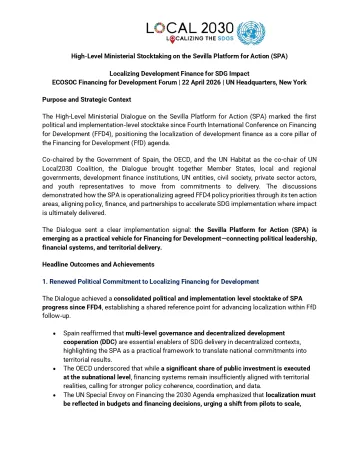
High-Level Ministerial Stocktaking on the Sevilla Platform for Action: Localizing Development Finance for SDG Impact ECOSOC Financing for Development Forum
The High-Level Ministerial Dialogue on the Sevilla Platform for Action (SPA) marked the first political and implementation-level stocktake since Fourth International Conference on Financing for Development (FFD4), positioning the localization of development finance as a core pillar of the Financing for Development (FfD) agenda.Co-chaired by the Government of Spain, the OECD, and the UN Habitat as the co-chair of UN Local2030 Coalition, the Dialogue brought together Member States, local and regional governments, development finance institutions, UN entities, civil society, private sector actors, and youth representatives to move from commitments to delivery. The discussions demonstrated how the SPA is operationalizing agreed FFD4 policy priorities through its ten action areas, aligning policy, finance, and partnerships to accelerate SDG implementation where impact is ultimately delivered.The Dialogue sent a clear implementation signal: the Sevilla Platform for Action (SPA) is emerging as a practical vehicle for Financing for Development—connecting political leadership, financial systems, and territorial delivery.
Sevilla Platform for Action Launched to Boost Local Finance for Sustainable Development
Sevilla Platform for Action Launched to Boost Local Finance for Sustainable Development
High-Level Ministerial Stocktaking on the Sevilla Platform for Action: Localizing Development Finance for SDG Impact ECOSOC Financing for Development Forum
From local priorities to fundable territorial solutions: The Bilbao Bootcamp
The Bilbao Bootcamp provides a practical platform for advancing the localizing finance agenda by bringing together country teams, United Nations entities, governments, financing institutions and other partners to develop territorial financing solutions. This approach originated with the Bilbao Local Finance Design Sprint: Scaling Local Solutions through Strategic Financing, held from 14 to 16 May 2025. The event was co-hosted by the Basque Government, the Joint SDG Fund and the Local2030 Coalition, in partnership with the World Rural Forum, the Bilbao City Council, the BBK Foundation and UN Etxea. As part of the "Road to Seville: the Local Way", the Design Sprint brought together stakeholders from eight countries to co-create financing solutions tailored to country contexts and local priorities, demonstrating how a systems approach to subnational financing can establish concrete pathways for sustainable development.
Following FfD4 and the launch of the Sevilla Platform for Action, the Bilbao Bootcamp II, held from 9 to 11 June 2026, scaled up this approach. It brought together the original eight-country cohort alongside a new cohort of 12 countries. Utilizing the Localization Blueprint, the SDG Localization Marker, co-creation methodologies, peer learning, Exchange Laboratories and direct engagement with financing partners, the Bootcamp supported countries in advancing fundable territorial solutions. Through these actions, the Bilbao processes advance the ambitions of the Sevilla Platform for Action to create enabling environments for development finance, strengthen capacities, and scale up transformative local financing solutions.
-
Events
Bilbao Bootcamp II Advances Territorial Finance Solutions Across the Globe
From 9 to 11 June 2026, the second Bilbao Bootcamp will bring together representatives from 20 countries for three days of intensive collaboration focused on strengthening territorial finance solutions for sustainable development.Hosted in Bilbao by the Government of Spain, the Basque Government, the Local2030 Coalition, and the University of Deusto, the Bootcamp will provide a platform for territories to refine investment-ready proposals and engage directly with investors, development finance institutions, and philanthropic partners.Participants from the 2026 cohort will present a diverse range of financing initiatives designed to address local development challenges, including a metropolitan public trust serving 22.7 million residents in Mexico, a territorial green fund in Mauritania and a credit guarantee facility supporting agribusinesses in Cambodia.The event will also showcase progress from the 2025 cohort, with representatives from Cabo Verde, Colombia, Ethiopia, Honduras, Jordan, Nepal, the Philippines and Tanzania sharing lessons and results from implementation efforts already underway.By connecting territories with financing partners and practical expertise, Bilbao Bootcamp II will reinforce the importance of locally led solutions and demonstrate growing momentum behind territorial approaches to sustainable development. The discussions and partnerships that will be forged during that week will continue to support the development and implementation of innovative financing mechanisms capable of delivering lasting impact in communities around the world. -
Actualizaciones
Bilbao Bootcamp II Advances Investable Territorial Solutions for Sustainable Development
ActualizacionesBilbao Bootcamp II Advances Investable Territorial Solutions for Sustainable Development
From 9 to 11 June 2026, Bilbao, Spain, welcomed government representatives, United Nations partners, investors, development finance institutions, philanthropies, and territorial leaders from around the world for the second edition of Bilbao Bootcamp, a global platform dedicated to advancing local financing solutions for the Sustainable Development Goals (SDGs).Co-hosted by the Government of Spain, the Basque Government, the United Nations Joint SDG Fund, and the United Nations Local2030 Coalition, the Bootcamp brought together participants from 20 countries to strengthen the financing, partnerships, and governance mechanisms needed to accelerate sustainable development at the territorial level.Building on the success of the inaugural 2025 edition, Bilbao Bootcamp II focused on scaling and structuring investable territorial solutions through the Local2030 Localization Blueprint and SDG Localization Marker. The event was designed to move beyond project-based approaches and support systemic territorial transformation by aligning public finance, governance reforms, and private capital around locally defined development priorities.Over three days, participants engaged in technical design workshops, leadership roundtables, thought leadership sessions, and investment matchmaking opportunities aimed at transforming promising local initiatives into bankable financing solutions. Twelve countries participating in the 2026 scale phase — including Cambodia, Costa Rica, Côte d’Ivoire, Guatemala, Kenya, Mauritania, Mexico, Mozambique, Senegal, Serbia, South Africa, and Thailand — worked alongside technical experts and financing partners to refine investment propositions capable of delivering sustainable impact at scale.The solutions presented reflected the diversity of territorial challenges and opportunities across regions. Proposals ranged from a Metropolitan Public Trust designed to serve 22.7 million residents in Mexico, to a territorial green fund in Mauritania, and a credit guarantee facility supporting agribusiness development in Cambodia. More than conceptual ideas, these initiatives were presented as structured investment opportunities backed by government ownership, implementation pathways, and clear development objectives.A key feature of the Bootcamp was the opportunity for participating territories to present their proposals directly to panels of investors, development finance institutions, and philanthropic organizations. These exchanges helped strengthen the investment readiness of the projects while creating new opportunities for partnership and resource mobilization.The event also highlighted progress achieved by the 2025 pilot cohort, which included Cabo Verde, Colombia, Ethiopia, Honduras, Jordan, Nepal, the Philippines, and Tanzania. These countries shared lessons from implementation and demonstrated how catalytic financing can be leveraged to generate tangible development outcomes. Collectively, the 2025 cohort secured USD 23 million in catalytic financing and is expected to mobilize more than USD 185 million in additional investment, illustrating the potential of territorial financing approaches to unlock significant resources for sustainable development.Guided by the principles of the Local2030 Localization Blueprint, discussions throughout the Bootcamp emphasized that successful SDG financing depends not only on access to capital, but also on the strength of territorial governance systems, public financial management, institutional coordination, and long-term development planning. Participants explored how local financing solutions can contribute to broader policy reforms, strengthen enabling environments for investment, and support the implementation of global commitments on financing for development.The Bootcamp also served as an important platform for connecting territories with a growing community of practice dedicated to localizing finance. Through peer learning, technical collaboration, and cross-sector dialogue, participants exchanged experiences and identified opportunities to replicate successful approaches across different contexts.By the close of the event, Bilbao Bootcamp II had reinforced its role as a leading global platform for territorial finance innovation. The partnerships formed, solutions refined, and financing conversations initiated during the three days will continue beyond Bilbao, supporting the development of investable territorial solutions capable of accelerating SDG implementation and delivering lasting impact for communities.As countries seek new ways to finance sustainable development, Bilbao Bootcamp II demonstrated that locally driven solutions, supported by strong partnerships and innovative financing mechanisms, can help bridge the gap between global ambitions and tangible results on the ground. -
Library
Bilbao Bootcamp II. From Territorial Priorities to Financing Pathways:Strategic Outcomes Report
LibraryBilbao Bootcamp II. From Territorial Priorities to Financing Pathways:Strategic Outcomes Report
The Bilbao Bootcamp II exemplified how United Nations country teams, Resident Coordinator Offices, host governments and financing partners can deliver co-created, bankable local initiatives, directly operationalizing the Seville Platform for Action on Localizing Finance and establishing an evidence-based roadmap leading to the 2027 SDG Summit. Ultimately, the central lesson from the event is that localization is an active delivery agenda where financing must respond directly to territorial priorities. This transformation hinges on strong country ownership, effective multilevel governance, coherent United Nations support and early engagement across public, private and development finance partners. -
Library
Bilbao Bootcamp II: Scaling and Building Investable Territorial Solutions through the Localization Blueprint and the Marker 2.0
The Second Edition of the Bilbao Blueprint Bootcamp evolved into a global convening, designed to inspire, connect, and equip a broader coalition of stakeholders. With a focus on local financing solutions for the SDG transitions, the 2026 edition integrated inspiring sessions with thought leaders, thematic roundtables, and technical design workshops led by practitioners to foster bold thinking, practical innovation, and investment matchmaking.The Bootcamp supported the piloting of territorial transformation solutions in selected countries, with the explicit objective of informing national public policy frameworks and replication across territories. By linking subnational innovation with national reform and global agendas, the initiative aimed to catalyze systemic change that accumulates from the local to the global level. The objective was not merely to finance projects, but to demonstrate how territorially anchored financing solutions can reshape governance systems, inform national reform, and collectively drive global sustainable development.
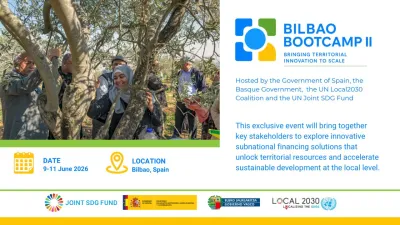

Bilbao Bootcamp II Advances Territorial Finance Solutions Across the Globe
Bilbao Bootcamp II Advances Investable Territorial Solutions for Sustainable Development
Bilbao Bootcamp II Advances Investable Territorial Solutions for Sustainable Development
Bilbao Bootcamp II. From Territorial Priorities to Financing Pathways:Strategic Outcomes Report
Bilbao Bootcamp II. From Territorial Priorities to Financing Pathways:Strategic Outcomes Report
Bilbao Bootcamp II: Scaling and Building Investable Territorial Solutions through the Localization Blueprint and the Marker 2.0
Working groups and task forces
The member entities of the Local2030 Coalition advance collective work through thematic inter-agency working groups and task forces, which bring together United Nations entities to drive coordinated action on SDG localization. These groups serve as operational platforms for coordination, technical collaboration, knowledge exchange, and the development of practical tools, guidance and initiatives that support the implementation of the 2030 Agenda at the local level. The working groups contribute directly to the implementation of the Sevilla Platform for Action, helping to translate global commitments on localization, financing, capacity development and multilevel governance into tangible results at the national and local levels.
Working Group 1 – Localizing the six SDG transitions. Co-led by the United Nations Department of Economic and Social Affairs (UN DESA), Food and Agriculture Organization of the United Nations (FAO), International Labour Organization (ILO), and United Nations Human Settlements Programme (UN-Habitat), with the United Nations Development Programme (UNDP) as a member, it develops practical approaches to translate the six transitions into integrated territorial action.
Working Group 2: Co-led by UNDP, the United Nations Environment Programme (UNEP), and UNICEF, with UN-Habitat and the United Nations Economic Commission for Africa (ECA) as members. This group focuses on financing the six SDG transitions at the local level. The group promotes policies, tools and innovative approaches to mobilize local financing resources. By strengthening connections between local, national and global financing processes, the group works to expand access to finance, foster investment partnerships and enable locally led sustainable development outcomes.
Capacity Building Task Force: Co-led by the United Nations Development Coordination Office (DCO), UN DESA, and the Local2030 Secretariat, this task force serves as the Coalition's central coordination mechanism for SDG localization capacity development. It brings together United Nations entities and partners to strengthen coherence across localization training, tools, guidance, technical assistance and peer-learning initiatives. It also identifies gaps and opportunities for collaboration, and facilitates access to expertise and resources for Resident Coordinators, United Nations Country Teams, governments and other key stakeholders. Through these efforts, the task force seeks to strengthen capacities at all levels, promote the integration of localization into United Nations programming and enhance the collective impact of SDG localization initiatives.
-
Library
Recommendations for the UN Water Conference: Multilevel Action to Achieve SDG 6
This brief presents key recommendations by the United Nations Local2030 Coalition for the 2026 United Nations Water Conference to Accelerate the Implementation of Sustainable Development Goal (SDG) 6, with five years to 2030, when decisions on SDG 6 and broader SDGs will have lasting impacts at the local level. Amid compounding climate impacts, rising water insecurity, widening inequalities, growing macro-economic pressures, and persistent gaps in achieving SDG 6, the Conference is tasked with accelerating implementation, addressing implementation gaps, strengthening global water governance, and sustaining momentum on water as a central global development priority. The growing recognition of water as a connector for child and human rights, gender equality, adequate housing, climate resilience, food security, human mobility and displacement dynamics, health, biodiversity, and sustainable development underscores the need for global water commitments to be anchored in local realities and grounded in a human rights-based, gender-responsive approach. Through a local lens, water intersects with multiple SDGs, directly affecting the quality and availability of drinking water, sanitation, and other sectors of the local economy. Local-level engagement is therefore crucial to translate water commitments into concrete realities through locally driven solutions that create impact. -
Library
Recommendations for COP31: Localizing Climate Action to Accelerate Sustainable Development
The policy brief, "Recommendations for COP31: Localizing climate action to accelerate sustainable development" (November 2026), highlights the importance of localizing climate action through stronger multilevel governance, inclusive local ownership and increased subnational implementation capacity. It argues that local and regional governments are essential to translating global climate, biodiversity and land commitments into tangible results on the ground. The brief sets out five recommendations for COP31: embedding multilevel governance localization in implementation frameworks; investing in local data, monitoring and accountability; advancing integrated territorial approaches across the Rio Conventions; scaling direct finance for local climate action; and recognizing localization as essential climate infrastructure.
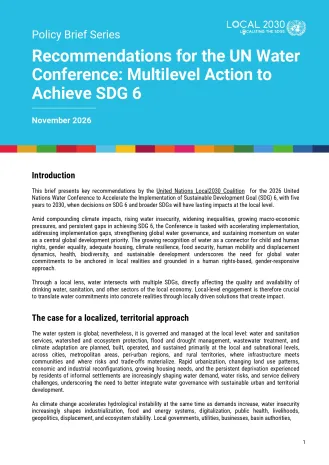
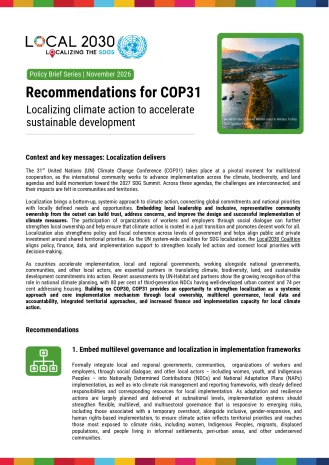
Recommendations for the UN Water Conference: Multilevel Action to Achieve SDG 6
Recommendations for COP31: Localizing Climate Action to Accelerate Sustainable Development
The Knowledge and Scientific Network and youth engagement
The Local2030 Coalition Knowledge and Scientific Network (KSN) is a dynamic global platform that bridges academic research, scientific knowledge and local solutions to accelerate progress toward the SDGs. By connecting researchers, policymakers, community leaders and practitioners through online training programmes, scalable science–policy interfaces, and pilot projects in Tunisia and Jordan, with second phased planned in Vietnam and Myanmar, the network strengthens the evidence base for localisation and promotes the systematic use of context-specific data in territorial decision-making. Established under the Local2030 Coalition and implemented in partnership with UN-Habitat and the Centre for International Political Studies (CeSPI), it brings together more than 100 universities and research centres to strengthen science–policy interfaces, applied research and evidence-based territorial decision-making.
The KSN Innovation Labs
These labs showcase outstanding university-led initiatives that translate research into locally applicable solutions. The currently validated examples are Utah Valley University, Cagayan State University, the University of South Africa and the University of Granada, illustrating the power of applied research and scientific innovation in driving territorial transformation.
Young people are at the forefront of driving local action for sustainable development. Through its Youth Strategy, the Local2030 Coalition works to strengthen youth participation in decision-making processes, amplify youth-led solutions and create opportunities for meaningful engagement across local, national and global levels. By connecting young leaders with governments, academia, civil society, the private sector and the United Nations system, the Coalition helps ensure that youth voices, priorities and innovations contribute directly to the implementation of the 2030 Agenda.
The Coalition has supported youth engagement across major global processes, including FfD4, the Second World Summit for Social Development (WSSD2), the 30th session of the Conference of the Parties to the United Nations Framework Convention on Climate Change (COP30), and the 13th session of the World Urban Forum (WUF13). Through youth consultations within the "Road to..." processes, capacity-building activities and participation in global forums, young people have helped shape policy discussions while showcasing locally led solutions and innovative approaches to sustainable development.
-
Events
III International SDG Forum: From Research to Action Brings Global Leaders Together in Paraná, Brazil
From 16 to 18 March 2026, Curitiba (Paraná, Brazil) will welcome global leaders, researchers, policymakers, youth representatives, and Local2030 Hubs for the III International SDG Forum: From Research to Action, co-organized by the United Nations Local2030 Coalition, Fundação Araucária, and the Government of Paraná.From 16 to 18 March 2026, Curitiba, Paraná, hosted the III International SDG Forum: From Research to Action, convening researchers, policymakers, Local2030 Hub representatives, youth leaders, civil society organizations, and international partners from around the world to explore how science, innovation, and local action can accelerate progress towards the Sustainable Development Goals (SDGs).Organized within the framework of the United Nations Local2030 Coalition and hosted by the Paraná Local2030 Hub through the General Superintendence of Economic and Social Development (SGDES) and the Araucária Foundation, the Forum focused on strengthening the connection between scientific knowledge and territorial action.Building on previous editions held in Utah, USA (2022) and Bilbao, Spain (2024), this year's Forum highlighted the role of territories as centers of transformative innovation and demonstrated how partnerships between academia, governments, communities, and the private sector can create evidence-based solutions to local and global challenges.Over two days of discussions, participants exchanged experiences and best practices around three key themes:Territorial innovation and systemic transitions, exploring how research and innovation can support sustainable development at the local level.Territorial coalitions and multilevel governance, highlighting the role of Local2030 Hubs in fostering collaboration, policy alignment, and SDG localization.Indigenous, ancestral, and community knowledge, emphasizing the importance of integrating diverse knowledge systems to build resilient and inclusive territories.The Forum featured keynote presentations, thematic panels, and interactive dialogues involving representatives from Paraná, Cabo Verde, Euskadi, and Buenos Aires, as well as universities, international organizations, and public institutions from across the globe. It also featured dedicated presentations from the United Nations Local2030 Coalition’s Hubs, centers of excellence established to build capacities for innovative action and nurture the development of and access to methodologies and tools for SDG localization.A recurring message throughout the event was the importance of translating research into action. Participants underscored the critical role of higher education institutions and young researchers in generating knowledge that informs public policy and supports sustainable territorial development.The Forum concluded with the adoption of the Paraná Declaration, reaffirming a shared commitment to evidence-based policymaking, multilevel cooperation, and stronger partnerships between science and society to advance the implementation of the 2030 Agenda.On the final day, participants took part in dedicated meetings of the Local2030 Knowledge and Scientific Network and Local2030 Hubs, followed by technical visits showcasing Curitiba's internationally recognized approaches to urban resilience, environmental management, and cultural heritage preservation.The III International SDG Forum reinforced the growing global movement to localize the SDGs through collaboration, innovation, and knowledge sharing, demonstrating that meaningful and lasting transformation begins in territories and communities. -
Library
Youth Consultation towards the Fourth Financing for Development Conference (FFD4) Consultation Report
This consultation was convened as part of the broader “Road to Seville: The Local Way” initiative, a participatory process leading up to the Fourth International Conference on Financing for Development (FFD4) in June 2025. In this context, the youth consultation offered a space for young leaders, entrepreneurs, and representatives to engage in dialogue on financing challenges and solutions from a local perspective. It facilitated the sharing of best practices, innovative approaches, and practical tools, and contributed to a global synthesis of youth-led case studies that highlight the transformative potential of localized development finance in accelerating inclusive and sustainable development. -
Events
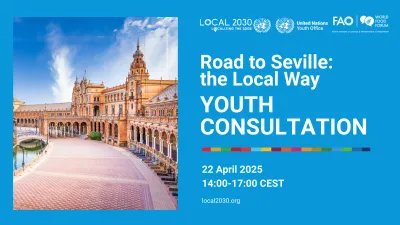
Youth Consultation towards the Fourth International Conference on Financing for Development
The Fourth International Conference on Financing for Development (FfD4), set for 30 June – 3 July 2025 in Seville, Spain, marks a crucial milestone in assessing progress on the Addis Ababa Action Agenda (AAAA) at its 10-year anniversary and advancing localized finance for sustainable development. As gaps in financing for the Sustainable Development Goals (SDGs) continue to persist, global forums such as COP29, the High-Level Political Forum, regional finance dialogues and lately the Pact of the Future emphasize redirecting climate finance to local adaptation, integrating nature-based solutions, increasing concessional finance, and strengthening subnational fiscal autonomy to better align with local development needs. However limited access to credit, lack of financial literacy, high-interest rates, and collateral requirements further restrict financial participation particularly for youth, women, and small businesses; limiting their ability to invest, innovate, and scale operations. In the developing world, small and medium entreprises make up 90% of the private sector and create more than 50% of jobs in their corresponding economies. With 73% of Gen Z and Millennials prioritizing ESG investments, leveraging blended finance, impact investment, digital innovation, and public-private collaboration is essential to bridge financial gaps, expand markets, and drive sustainable economic growth through inclusive financial systems. In view of this, the Local2030 Coalition, in collaboration with the United Nations Youth Office and the Food and Agriculture Organization of the United Nations World Food Forum, is co-organizing youth-led consultations bringing together young representatives, experts and practitioners from public and private sectors to identify practical challenges, lessons learnt and good practices to strengthen youth entrepreneurship, expand access to sustainable financing, and ensure local actors are at the forefront of SDG acceleration. Date and time: 22 April 2025 | 14:00-17:00 CEST Venue: Online Objectives: Identify the key challenges hindering youth access to finance at the local level and their expectations from the FfD4. Identify current efforts and gaps in addressing sustainable financing and multi-level approaches to achieving the SDGs. Identify innovative financing mechanisms and successful local models in different regions. Main outcomes: Concrete report documenting key challenges, messages, policy recommendations, and best practices to strengthen localized finance strategies and implementation. Database of the different participants to the event for follow-up. -
Actualizaciones
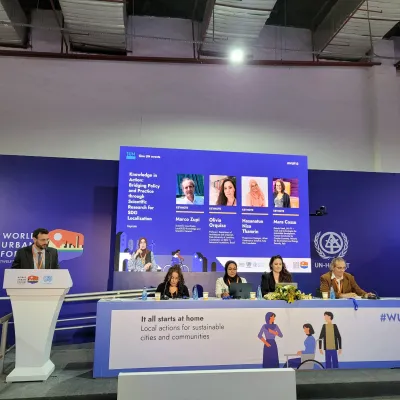
Knowledge in Action: Bridging Policy and Practice through Scientific Research for SDG Localization
ActualizacionesKnowledge in Action: Bridging Policy and Practice through Scientific Research for SDG Localization
On 8 November 2024 in Cairo, Egypt, a One UN event titled “Knowledge in Action: Bridging Policy and Practice through Scientific Research for SDG Localization” at the Twelfth Session of the World Urban Forum (WUF12) explored how research and policy can come together to localize the Sustainable Development Goals (SDGs). This event was organized by the Local2030 Knowledge and Scientific Network (KSN), a key initiative of the Local2030 Coalition, in collaboration with UN-Habitat, Food and Agriculture Organization of the UN, CeSPI ETS and the Italian Ministry of Foreign Affairs and International Cooperation. The session brought together policymakers, practitioners, researchers and PhD students to exchange ideas on driving meaningful local actions informed by global knowledge. A Platform for Collaboration and Learning The event was structured to foster collaboration and learning, starting with presentations on international initiatives that bridge academia, policymaking and sustainable development. Highlights included: Araucaria Foundation, Brazil: Showcased their partnerships that extend beyond academia to engage a wide range of stakeholders in Paraná State. Yup Cities Project: Highlighted the power of youth involvement in participatory processes and sustainability education through the "Lesson 0 for Sustainability" initiative. Changemakers Initiative, Italy: Demonstrated evidence-based approaches to urban regeneration, supported by the Italian Ministry of Environment and Energy Security. These presentations set the stage for a deep dive into the national contexts of Tunisia and Jordan, two pilot countries of the KSN. The Mayor of Irbid, Jordan, and a representative from National Federation of Tunisian Municipalities shared successes and challenges in SDG localization. In addition, the Tunisian and Jordanian KSN researchers shared insights from their projects, addressing some of the mentioned challenges. Key Themes Discussed The discussions underscored several critical themes essential to advancing SDG localization: Bridging Knowledge and Policy: Integrating global science initiatives with local policies to prevent fragmented efforts and ensure a holistic approach to SDG implementation. Youth Involvement and Inclusive Participation: Empowering young people and fostering inclusive participation are essential for advancing sustainable development and making informed decisions at the local level. Universities as Key Local Actors: With 250 million students globally, universities play a vital role in reshaping development models to prioritize sustainability over economic growth. Data and Research-Driven Policy: Research-driven initiatives, such as impact evaluations and community engagement, improve policymaking and data measurement. Localized Solutions for Specific Challenges: Practical examples from Tunisia and Jordan illustrate that collaborations between universities, municipalities and the private sector help address local challenges, such as urban resilience and social inclusion, effectively, leading to impactful and sustainable development. Recommendations for Action The session concluded with actionable recommendations for advancing SDG localization: Strengthen Collaborative Frameworks: Foster partnerships between global science initiatives, local governments and universities to turn research into actionable policies. Empower Youth: Create platforms for youth and diverse stakeholders to actively engage in policy-making and sustainable development projects. Shift Development Metrics: Encourage universities to develop and implement alternative data models that prioritize sustainability over traditional economic growth indicators. Promote Research-Driven Approaches: Promote the use of co-designed research methods, such as surveys and city forums, to align SDG targets with local realities for better-informed policies and impact assessment. Facilitate Partnerships: Enhance collaboration among municipalities, universities and private sector to leverage resources, expertise and public spaces for community-focused, inclusive and sustainable development. Conclusion The Knowledge in Action side event at WUF12 demonstrated the critical need for bridging academic knowledge with policies to advance the SDGs. By fostering partnerships, empowering youth and leveraging data-driven approaches, this event set the foundation for innovative, localized solutions that can create a sustainable and inclusive future for communities worldwide. About Knowledge and Scientific Network The Knowledge and Scientific Network, a key initiative of the Local2030 Coalition, bridges the gap between academic knowledge and policy-making by integrating insights from academia with practical needs of decision-makers. The KSN reaches across the world, involving various continents and fields of study, with a specific focus on interventions in two pilot countries: Jordan and Tunisia. The KSN engages researchers, particularly youth from Africa, Asia, and Latin America, to develop and implement research-based solutions. Through training programmes and research labs, the KSN transforms academic discussions into actionable policies, advancing SDG localization worldwide.
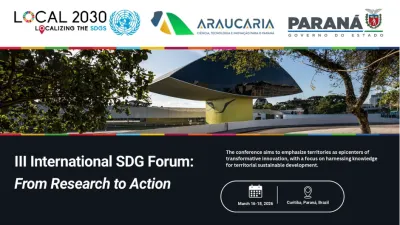

III International SDG Forum: From Research to Action Brings Global Leaders Together in Paraná, Brazil
Youth Consultation towards the Fourth Financing for Development Conference (FFD4) Consultation Report
Youth Consultation towards the Fourth International Conference on Financing for Development
Knowledge in Action: Bridging Policy and Practice through Scientific Research for SDG Localization
Knowledge in Action: Bridging Policy and Practice through Scientific Research for SDG Localization
The Partnership Platform on localizing the Sustainable Development Goals
The Partnership Platform on Localizing the SDGs is a joint operational initiative of the Italian Ministry of Environment and Energy Security and the United Nations Human Settlements Programme (UN-Habitat). Anchored in the Local2030 Coalition and the UN-Habitat Strategic Plan 2026–2029, the platform supports countries in designing national Sustainable Development Goal (SDG) localization frameworks. These frameworks establish the necessary governance architecture to connect national priorities with local delivery. By integrating public policies, institutional mechanisms and financial instruments into a coherent multilevel governance system, the platform enables a strategic shift from fragmented, project-based interventions to systemic, scalable territorial transformation.
Through structured spaces for dialogue and co-ordination across levels of government and sectors, the partnership platform actively reduces administrative fragmentation, streamlines decision-making, and accelerates the translation of global policy commitments into tangible outcomes on the ground. In less than two years, the platform has provided vital operational support to countries, including Italy, Senegal and Tunisia, in designing their respective national localization structures. For more information on these country frameworks and operational resources, users can visit the official SDG Localization website.
The 2026 annual meeting: Driving systemic impact at the High-Level Political Forum
The 2026 Annual Meeting of the Partnership Platform on Localizing the SDGs convenes at a critical juncture during the High-Level Political Forum on Sustainable Development (HLPF). Under the global theme "Transformative, equitable, innovative and coordinated actions for the 2030 Agenda and its SDGs for a sustainable future for all", the platform addresses three converging intergovernmental processes: the structural review of the United Nations Economic and Social Council (ECOSOC); the final in-depth thematic review of SDG 11 (Sustainable Cities and Communities) before the 2030 deadline; and the High-Level Meeting of the General Assembly on the midterm review of the New Urban Agenda.
Together, these processes offer a unique opportunity to renew political commitment and technical co-operation toward empowered subnational authorities, robust multilevel governance, and accelerated progress on housing, land management and basic services. SDG localization, anchored in policy coherence for sustainable development, serves as the critical enabler to bridge these agendas. By transforming global commitments into concrete local actions, the partnership platform ensures that international sustainable development and urban mandates are driven from the bottom up.
-
Events
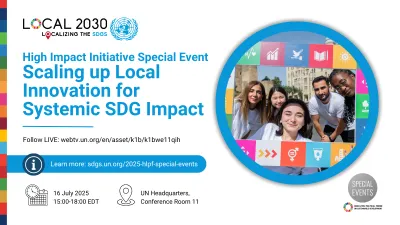
Local2030 Coalition High Impact Initiative Special Event at 2025 High-Level Political Forum
The 2030 Agenda for Sustainable Development, adopted in 2015, serves as a comprehensive blueprint to eradicate poverty, protect the planet, and ensure prosperity for all. Despite notable progress, challenges such as climate change, conflicts, and global health crises continue to impede advancement. As global efforts continue to accelerate the achievement of the Sustainable Development Goals (SDGs), there is an increasing emphasis on the power of localizing the SDGs, ensuring their implementation comes from the ground up and is rooted in community-led efforts, to foster impact and transformation. The 2025 High-Level Political Forum (HLPF), convened under the theme "Advancing Sustainable, Inclusive, Science- and Evidence-based Solutions for the 2030 Agenda for Sustainable Development and its Sustainable Development Goals for Leaving No One Behind," presents a critical opportunity to reinforce commitments and mobilize resources towards localizing and achieving the SDGs. During the 2025 HLPF, SDGs 3, 5, 8, 14, and 17 will be in review. Building upon the momentum generated from the High Impact Initiative (HII) on Localization, adopted at the 2023 SDG Summit, which elevates the crucial role of local action in achieving the global goals, and the 2024 Summit of the Future, which, through its Pact for the Future, emphasizes multilevel coordination, localization and sustainable urbanization as essential drivers to advance progress, the 2025 HLPF will be a vital moment for governments at all levels and stakeholders from diverse sectors to follow up on these processes and gather innovative, scalable solutions, to further localize the SDGs amidst the upcoming 2027 SDG Summit and the countdown to 2030. Within this context, the Local2030 Coalition is organizing this Special Event to demonstrate progress on localizing the SDGs and the six transitions through the presentation of tangible actions and solutions led at the local level. The event will do so by gathering actors from a wide range of sectors, including national governments, local and regional governments, civil society, the private sector, academia, and UN agencies, among others, reporting on the progress made towards the targets of the High Impact Initiative (HII) on Localization. The event will build on ongoing localization processes led by the Local2030 Coalition, its member UN Agencies and stakeholder constituencies, which are facilitating multilevel governance, policy coherence, and stakeholder engagement towards key global milestones such as FFD4, the 2025 World Social Summit, and COP30, among others. Objectives The Local2030 Coalition Special Event taking place at the 2025 HLPF aims to underscore the centrality of SDG Localization as a driver of transformation and inclusive development. Building on the progress and momentum generated towards implementing the High Impact Initiative (HII) on Localization, this session will highlight how local action, grounded in community-led solutions, is accelerating impact across the six SDG transitions. The event will serve as a platform for the Local2030 Coalition and its partners to: Showcase concrete results and promising practices emerging from the HII on Localization, demonstrating how local implementation of the six SDG transitions fosters integrated, inclusive, and impactful responses to global challenges. Foster multi-stakeholder dialogue on enabling environments for localization, with a particular focus on increasing capacity and mobilizing innovative and catalytic financing to scale up local action, unlock persistent bottlenecks, and drive forward inclusive implementation. Illustrate synergies among the High Impact Initiative on Localization and other High-Impact Initiatives to foster systemic transformation and collaboration among UN Agencies, governments, and stakeholders. -
Events
The Local2030 Coalition advances SDG localization at HLPF 2026 and the High-Level Meeting on the New Urban Agenda
The Local2030 Coalition engaged UN entities, Member States, local and regional governments, and local development partners at the 2026 High-Level Political Forum on Sustainable Development (HLPF) and the High-Level Meeting on the New Urban Agenda (HLM NUA), held in New York from 13 to 17 July 2026. Across both processes, the Coalition promoted SDG localization, multilevel governance and territorial approaches to sustainable development.The Coalition's engagement included:13 July – “Towards a Global Stocktake on SDG Localization: Achieving SDG 11 through a Territorial Approach” – Organized by the OECD, UN-Habitat, the Spanish Ministry of Foreign Affairs and the Local2030 Coalition.13 July – “Localizing the SDGs to Boost the Sustainability Transformation” – Co-organized by the UN Global Compact Network Finland, UN-Habitat, the Local2030 Coalition and Italy.14 July – Annual Meeting of the Partnership Platform on Localizing the SDGs – Convened by the Italian Ministry of Environment and Energy Security, UN-Habitat and the Local2030 Coalition.14 July – Launch of the Local2030 Working Group 1 Policy Brief – Organized by the Local2030 Coalition's Working Group 1.14 July – “Universal Access to Water and Sustainable Energy for Building Resilient, More Inclusive Communities” – Organized by Spain, with the Local2030 Coalition, Ecuador, Cabo Verde, the Joint SDG Fund and the Inter-American Development Bank.14 July – Local and Regional Governments Forum – Convened by UN-Habitat, the Local2030 Coalition, UN DESA, UNDP and the Global Taskforce of Local and Regional Governments.15 July – “From Local to Global: Regions Driving Multi-Level Action for the SDGs and the Water–Energy Nexus” – Organized by Regions4 in collaboration with the Local2030 Coalition.15 July – Local2030 Coalition Special Event – Organized by the Local2030 Coalition.16 July – High-Level Meeting on the New Urban Agenda: Opening and Plenary Segments.17 July – Multi-stakeholder Panel 1: “Delivering for People: Scaling Adequate Housing, Land, Basic Services, and Inclusion.”17 July – Multi-stakeholder Panel 2: “Unlocking Delivery: Financing Sustainable Urbanization at Scale.”17 July – Multi-stakeholder Panel 3: “Delivering Urban Resilience in an Era of Escalating Crises on Climate, Disaster and Environmental Risk.”17 July – Multi-stakeholder Panel 4: “Activating Future-Ready Cities through Governance, Capacity, Data, Innovation and Digital Transformation.”The discussions highlighted the importance of political ownership, institutional coordination, local and regional representation in global review processes, and financing for SDG delivery. The HLPF also advanced the Coalition's partnership and policy work through the Annual Meeting of the Partnership Platform and the launch of the Policy Brief ‘Localizing the SDGs by Advancing the Six Transitions at the Local Level’, while discussions on water, energy and regional cooperation reinforced the value of integrated approaches.At the HLM NUA, discussions focused on adequate housing, basic services, sustainable urban finance, resilience, governance, capacity and innovation, connecting the 2030 Agenda with the implementation of the New Urban Agenda.Together, these engagements strengthened the links between global commitments and territorial action, contributing to the Coalition's broader Road to the 2027 SDG Summit and positioning SDG localization as a key pathway for accelerating progress towards the 2030 Agenda.